Beginning :: End
The Story
The seawall, late summer, golden hour. I'd been walking for an hour, camera already an extension of my arm, eye tuned the way it gets when you stop noticing you're walking and start noticing what the streets are about to do. Not tired. The opposite of tired. In the zone.
I was coming up on Second Beach, the pool, that part of the seawall right where you start to feel like you're actually entering Stanley Park. The light was getting low and orange, the way it does there in August. And then I saw it.
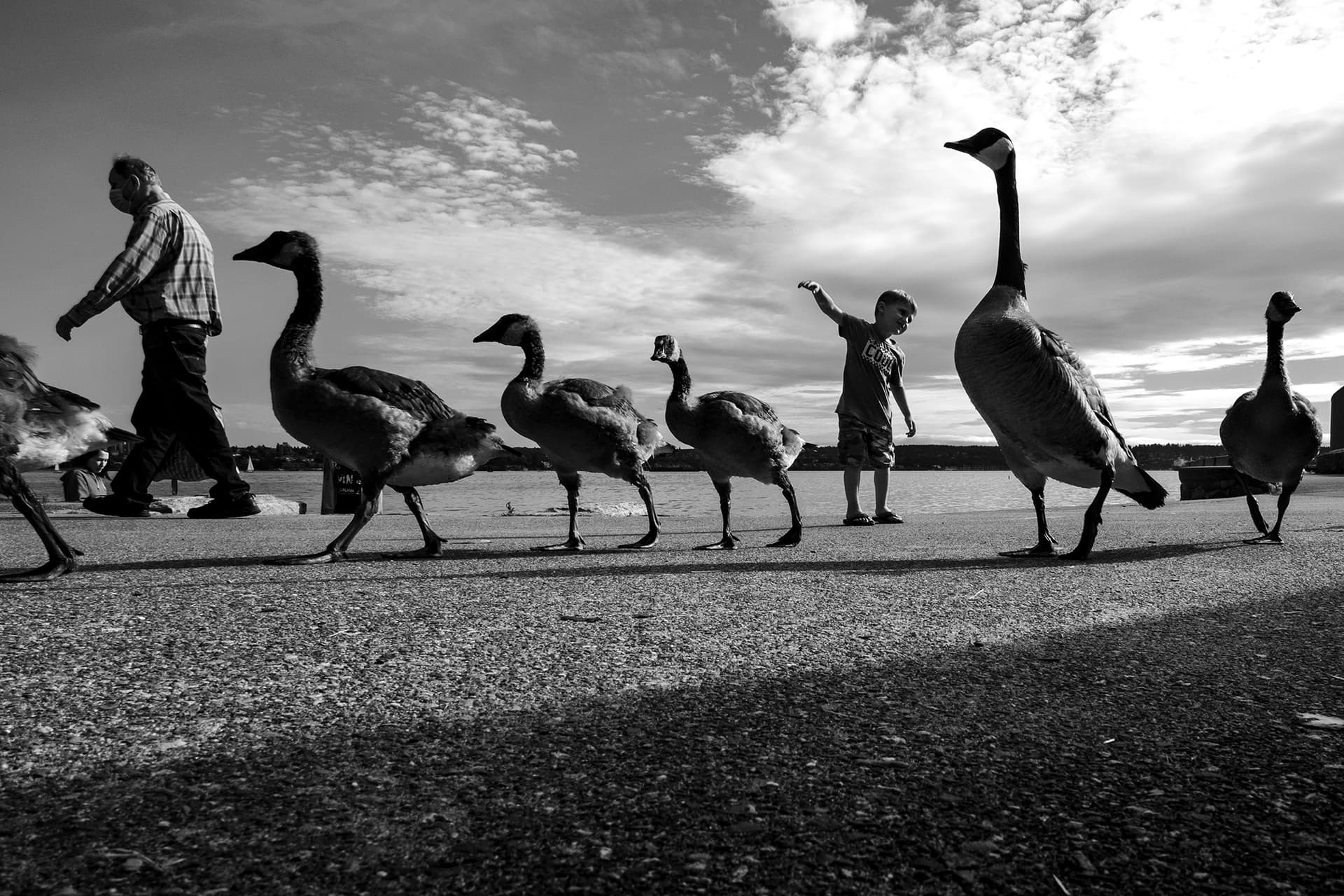
The geese first. A line of them, moving toward the water, single file, in that procession-like way only geese pull off. Behind them, an old man, hands in his pockets, taking his time. Further back, a kid, running. Three vectors, none of them talking to each other, all of them headed somewhere they'd intersect for maybe four seconds before scattering forever.
You see it and you move. That's the part nobody really teaches. The decisive moment in a street photograph is rarely a single second. It's a small window, and your job is to be inside it before it closes. I sped up, dropped my elevation, found a low angle that would let the lead goose own the right side of the frame and the rest of the line trail left like a brushstroke. Shot a handful of frames. I already knew one of them was in there.
16mm. Low. The wide angle stretches the procession into something cinematic. The lead goose, neck tall, profile cut clean against the sky. The other geese cascading left. The old man at the back. The kid in the middle, mid-step, one arm halfway up, half-mirroring without thinking about it. Black and white in the edit, because the colour was already there in the light, and adding more would've only argued with it. Horizon dead centre. Sun low to the right.
I called it Beginning :: End. The kid is the beginning. The old man is the end. The geese are what runs through, the part that doesn't change. Everyone in the photograph's walking the same direction, and none of them know they're walking together.
You can't manufacture this kind of frame. But you can stand in the path of where it might land, camera ready and the legs willing to close the gap. That afternoon I caught the right four seconds. Most of this work, in the end, is walking long enough to be ready when the seawall throws something at you. Then being a few steps ahead of it when it lands.
Why It Works
Composition
The horizon sits dead centre, not on a third. Yes, I know. But the rest of the geometry pays it back. The middle row of the rule-of-thirds grid houses every figure: geese, kid, old man, all packed into one horizontal strip. And the upper-right power-point dot lands directly on the kid's head. That's not coincidence. That's the eye anchor.
Turn on the golden-spiral top-right variant and you'll see why this frame holds. The spiral resolves into the exact same area as the upper-right power point: the kid's head and the lead goose's neck, both wrapped inside the spiral's smallest construction rectangle. Two different compositional rules, thirds and golden ratio, agreeing on the same focal point. The eye gets pulled there twice. The rest is light and timing.
Light & Tone
Golden hour, sun setting low to the west, on my right as I shot. Sidelight, not backlight. The geese, the kid, the old man each cast a long shadow to the left, three parallel echoes laid across the pavement that make the foreground feel like more than just ground. The cloud structure holds the highlights. The figures cut dark against the bright dome of sky.
Black and white in the edit because the colour palette had already collapsed to two values: the bright sky and the dark figures against it. Adding chroma would've argued with what the light was already saying.
Punctum
Roland Barthes's word for the detail that pricks you and won't let go. Here it's the kid's right arm, halfway up. Not a salute. Not a wave. Just a half-conscious mirror of the goose ahead of him, the kind of gesture that happens before language gets there. You don't notice it the first time. The second time, you can't un-see it.
Timing
Cartier-Bresson called it the decisive moment. He meant the instant when form, content and meaning briefly agree. For this frame the window was about four seconds. The kid had to be mid-step. The geese had to be aligned in profile, not bunched. The old man had to be still trailing, not crowding the line. You can't plan that. You can only stand inside it when it happens.
Theme
A child following animals he doesn't yet name as different from himself. An old man taking his time toward the end of a walk. Canada geese, who migrate every year, doing what Canada geese always do. Three different relationships to time, all walking the same path, all unaware they're inside a triptych. I migrated north years ago. The photograph reads, to me, as a small note about the difference between moving forward and going somewhere.
Technical
- Camera
- FUJIFILM X-T3
- Focal length
- 16mm
- Aperture
- f/16
- Shutter
- 1/250s
- ISO
- 200
- Date
- JUN 22, 2020
- Location
- Vancouver, Canada
- Editor
- Lightroom