Skating Act
The Story
The Vancouver Art Gallery from Georgia and Howe. There's a huge TD Bank branch on that corner, all glass, and the way you enter the gallery plaza is by walking past it. You're inside the bank's reflection, then you're not. Like the theatre curtain pulling back. The show was already running.
Half a dozen skaters at the resting platform between the gallery's main steps. Running, jumping, falling, getting up, trying again. The kind of practice that doesn't care about the building behind it. The stone facade meant something. The skateboard meant something else. Both meanings were on the platform at the same time.
I tried first from the side facing the gallery, head-on. Got the trick close, got the body, got a few frames that worked. But something about the stairs kept pulling me. Their lines repeat across the plaza's full width, that pattern that holds the place together. Capriccio, that's the word that came in. Italian. A serious composition that lets a small wildness in. I wanted the stairs to do their share.
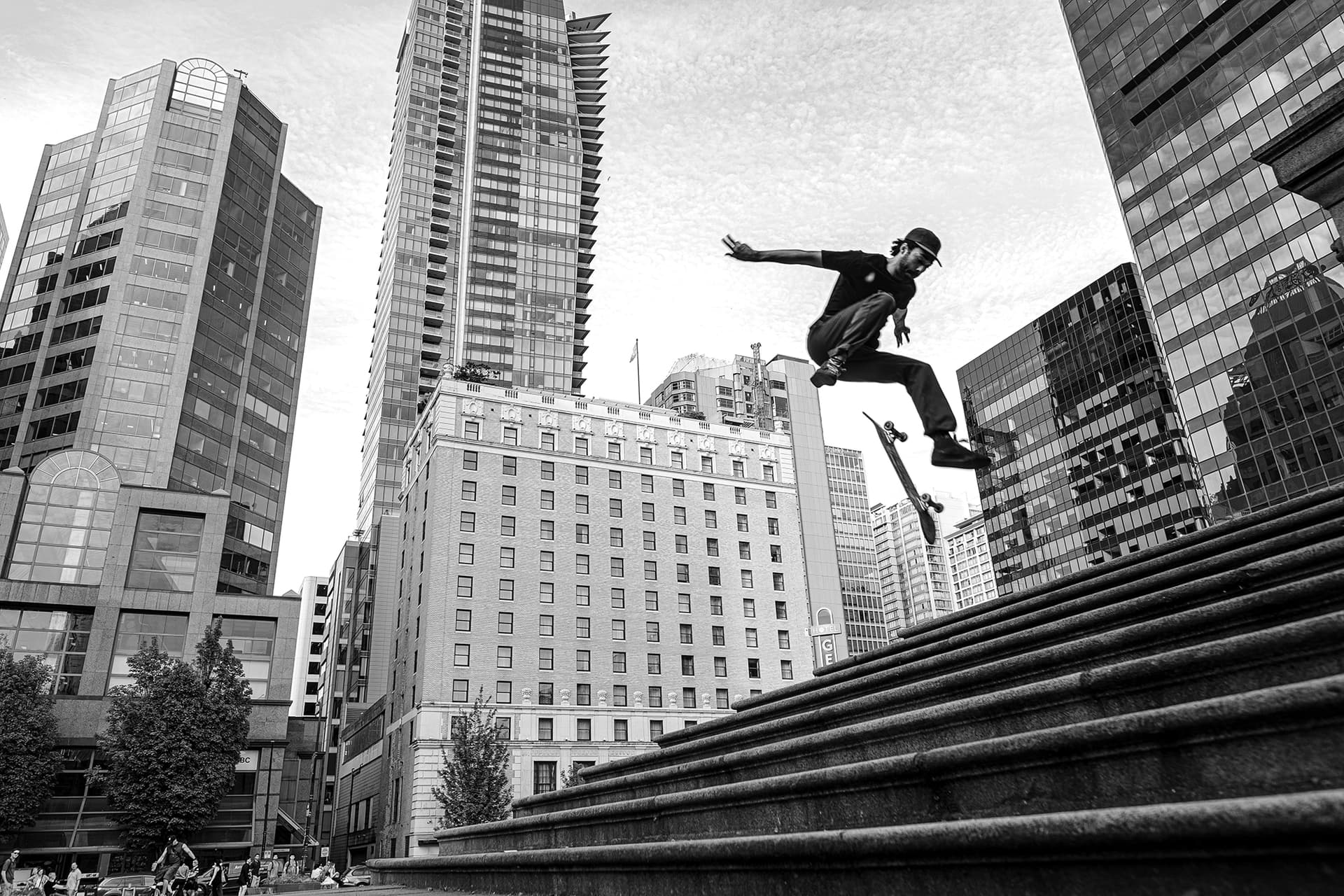
So I moved. Sneaked actually, low and slow, around to the back of the line of skaters so I wouldn't end up part of a landing. Found a spot close to the bottom step, looking up and across. Now the frame had the staircase taking its part of the work, the city skyline holding the rest, and the skater would have to land in the middle of it.
16mm. Low. Camera tilted just enough to give the staircase a working diagonal. Hotel Vancouver dead-centre behind, the glass towers framing left and right. The exposure set, the focus on the resting platform.
Then I waited. The next fearless one came in fast, ran the platform, and went up. Wait wait. Boom.
When I checked the screen, the stairs had given me their diagonal, the body had landed in the upper-right, and the city had not moved. I called it Skating Act. Not act as in performance. Act as in manifesto. The city is built rigid: glass walls that don't bend, heavy stone stairs that don't yield. Then a skateboard comes through and flows. Doesn't break the architecture. Doesn't break itself. Just moves through what was built to stay still.
Why It Works
Composition
The structure of the frame is the diagonal. From the upper-right corner the eye descends along an invisible line that passes through the skater's body. His tilted torso and bent leg follow it precisely, and the line continues down through the long stone steps until it exits at the lower-left. That diagonal anchors the right half of the picture and gives the city skyline on the left room to balance it.
The upper-right thirds power point lands on the skater's chest. Not his head, not the board, the chest. Call it a philosophical accident. The rules placed the rules-eye where his heart would be.
The second golden triangle, variant B, is the third structure at work. The skater functions as the gravitational force pulling the upper triangle's apex down toward him. The board, mid-flip, points directly at that apex. The triangle isn't drawn. It's enforced by where the body and the equipment have placed themselves. Three rules at one body. The eye reads the frame as a single descending act.
Light & Tone
Mid-day Vancouver, soft cloud cover diffusing the light. The kind of light that doesn't dramatize anything but lets the architecture and the figure read clearly. You can see every step's edge, every window in Hotel Vancouver, every glass panel in the towers. Detail across the entire frame. Black and white in the edit because the contest the photograph wanted to set up was structural, not chromatic. The stone hotel is its own grey. The stair stone is another grey. The glass towers are a third. The skater is the dark accent. Colour would have made it about the colour of someone's helmet, and that wasn't the picture.
Punctum
Roland Barthes again. The detail that pricks. Here it's the moment of suspension. The skater is at the top of his arc, both legs off the steps, the board separated from his feet, his arm out for balance. The photograph holds the half-second where gravity hasn't decided yet. The photograph also doesn't tell you whether he lands. That's the point. The half-second before the result is the act.
Timing
Skaters give you predictable repetition. They run the same line, jump from the same step, attempt the same trick over and over. That's a gift to the photographer. You don't have to see it once. You have to see it cleanly. I waited for one runner whose trajectory matched the diagonal I had set, whose airborne moment landed in the upper-right of my frame, whose body angle would echo the line of the stairs underneath. The next attempt did all of that. I tripped the shutter at the apex.
Theme
Skating Act. The word "act" as in manifesto. What is skating, and what is it for? The photograph answers: flow inside rigidness. The city's vocabulary is hard surfaces. Glass and stone, both built to resist. The skateboarder's vocabulary is the opposite. Bend the knees, redirect the energy, take the impact and turn it into the next motion. The two languages share the staircase for a few seconds at a time. The photograph captures the seam. The collection name is contracultura. This is what it looks like in motion.
Technical
- Camera
- FUJIFILM X-T5
- Focal length
- 16mm
- Aperture
- f/3.2
- Shutter
- 1/250s
- ISO
- 64
- Date
- JUN 2, 2023
- Location
- Vancouver, Canada
- Editor
- Lightroom