Because Zombies
The Story
Honda Celebration of Light, Portugal's night to host. Vancouver's annual fireworks festival packs the West End shoreline beyond capacity. The crowd shows up hours before dark to claim a square metre of grass.
I'd come early too. The sun was radiant, not a cloud in the sky, the kind of light that promises a clean sunset and delivers. The crowd was already the size of a small carnival. People sitting on towels, on bags, on the grass, on each other. No free spots. The rest of us improvising. A piece of curb, a chunk of driftwood, a square inch of unclaimed lawn.
I walked west, toward the part of the seawall where the path starts heading into Stanley Park. The crowd thinned just enough there, and I found a tiny piece of open grass. Tired by then. The afternoon had been a lot of sun and a lot of people. I sat. Camera still in my hand.
Resting my arms on my knees, I watched them move. The crowd at this kind of event behaves like a single organism. An ant colony moving the way the sea moves. People don't quite walk anywhere alone here. They drift in herds, against herds, around obstacles, and the whole mass keeps shifting like water finding its level.
I started thinking that it should be part of a frame. The unity of the mass. I wasn't sure what kind of frame yet. I opened the LCD screen and tilted the camera low because that helps me see when I'm shooting from below.
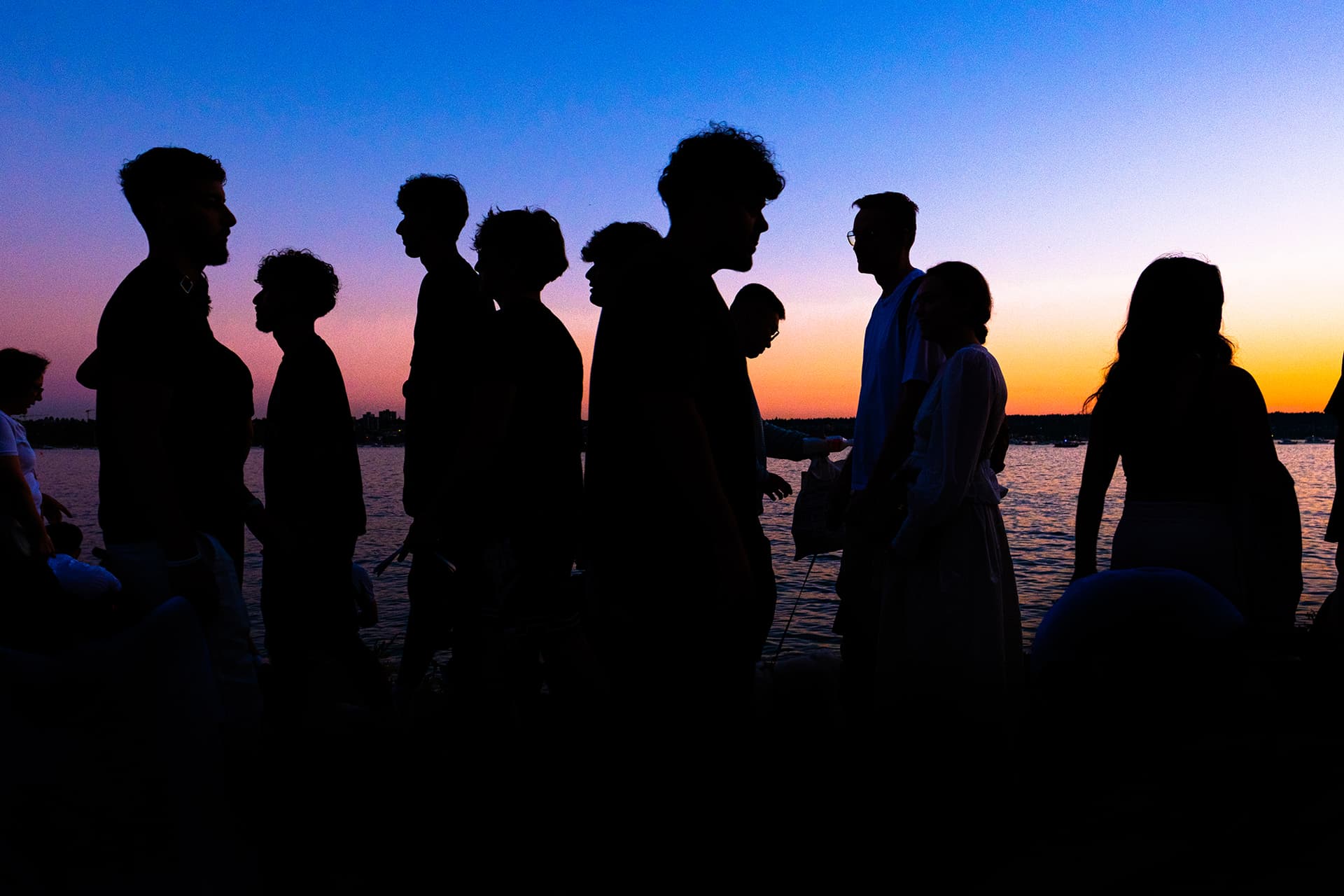
What appeared on the screen was a row of pure dark silhouettes against the gradient. The sun had sunk far enough that blue was taking over the sky, but orange was still fighting at the horizon. Behind every passing person the colours were doing the work of three lights. I started watching profiles.
Eight or nine people moved through the frame in the next minute. All of them in profile because of where I was sitting. You could see the shapes of their hair before you could see anything else. There's a haircut going around right now, K-pop adjacent, that I always read as Spike Spiegel from Cowboy Bebop. Everywhere you look in Vancouver, somebody is wearing it. Tonight, half the silhouettes had it.
A shot was taken. Probably more than one. Colour was the genesis of this frame. Black and white never stood a chance. The reason I raised the camera was the light, so the light is what I had to keep.
I called it Because Zombies. Not as a horror reference. Because that's what the line of them looked like on the LCD: a procession moving with one rhythm none of them had agreed to. The light was apocalyptic. The silhouettes were strangers walking the same direction at the same speed. Sometimes that's all the photograph wants you to notice.
Why It Works
Composition
The structural device here isn't a single focal anchor. It's the line. Eight or nine silhouettes spread across the middle horizontal band, all in profile, all walking the same direction at roughly the same speed. The composition is the procession.
The horizon, where the water meets the distant land in the orange band, sits dead centre on the x-axis symmetry line. Sky on top, water on bottom, the row of figures running across the spine. Turn on the y-axis too and the largest silhouette in the frame, the curly-haired figure near centre, sits roughly along that vertical mid-line. The procession is centred even when no single subject is.
Two of the smaller silhouettes have heads landing close to the upper-thirds power points. Not the main draw, but the eye still snags on them and then keeps moving. They function like punctuation across the row.
There's also a quieter flow if you turn on the golden-spiral bottom-right variant. The spiral starts at the lower left, passes through two figures whose heads are turned slightly toward each other, curves up into the sky, and finishes on the white-dress figure on the far right with the open space behind her. You don't have to see it for it to do its job. The eye is doing that walk anyway.
No single power point owns this frame. The figures distribute roughly along the rule-of-thirds verticals without locking to them. The eye doesn't land on one face. It walks through the row, profile by profile, the way the people themselves are walking. That's what makes it read as a procession instead of a portrait.
Light & Tone
Twilight on English Bay at the back end of Honda Celebration of Light. The sun had dropped far enough that blue was already taking the sky, but orange was still fighting at the horizon. That fight, between cool and warm, is the whole palette. Three or four bands of colour, no clouds to interrupt them, distance enough that the gradient looks like it was airbrushed.
Something occurred to me in post. This is the palette 80s design used to signal future. Magenta into orange, blue into purple, the synthwave gradient before synthwave had a name. Tron, Miami Vice, the airbrushed neon of arcade cabinets, all of them painted some version of this. Forty years later the sky was just doing it for free.
The figures stay pure black against this. Late twilight kills detail in anything dark and standing between camera and sun. Faces, clothes, expressions, all subtracted. What's left is shape. Colour was the genesis of this frame. Black and white never stood a chance. The reason I raised the camera was the light, so the light is what I had to keep.
Punctum
Roland Barthes again. The detail that pricks. Here it's a haircut. Specifically the K-pop adjacent profile cut that's everywhere in Vancouver right now. I always read it as Spike Spiegel from Cowboy Bebop, the anime detective, his exact head shape walking through frames. Once you see it, the whole row reads as anime extras crossing a sunset background plate.
Timing
This isn't a single decisive moment. It's a window of about ninety seconds. The light bands have to be saturated enough to read as gradient, the sun has to be far enough below the horizon that everything in front of it goes pure silhouette, and the crowd has to be moving densely enough that the line of figures spaces itself without gaps. Inside that window I shot more than one frame. This is the one where the row read like a sentence.
Theme
Because Zombies isn't a horror reference. It's a description of how the row of people read in the LCD. None of them had agreed to walk together. None of them were looking at each other. They moved with one rhythm anyway, around obstacles, with the same speed, like the surface of a single organism. The Honda fireworks bring out a Vancouver that doesn't exist any other night. Everyone in costume of their normal clothes, herded by whatever brought them here. I sat in the grass, watched the procession, took the picture, and gave the title to what I'd seen.
Technical
- Camera
- FUJIFILM X-T5
- Focal length
- 16mm
- Aperture
- f/5.6
- Shutter
- 1/250s
- ISO
- 500
- Date
- JUL 20, 2024
- Location
- Vancouver, Canada
- Editor
- Lightroom