Boat Diaries
The Story
Some days the city feels too familiar. You've walked it for a year, two years, six. The same corners give you the same answers. The eye gets bored before the legs do.
I work remote. By the last hour of any given day my head's already out the door, deciding where to walk, what light to try. That afternoon I wanted somewhere else. Not deeper into the same neighbourhood. Somewhere not mine. So I took the SeaBus.
There's something specific about the light inside a SeaBus. The windows are big, the interior is dark, so the light coming in picks its spots inside the cabin. Those spots fill with light, switch on. Whatever's outside them disappears. The cabin behaves like a portable chiaroscuro lab.
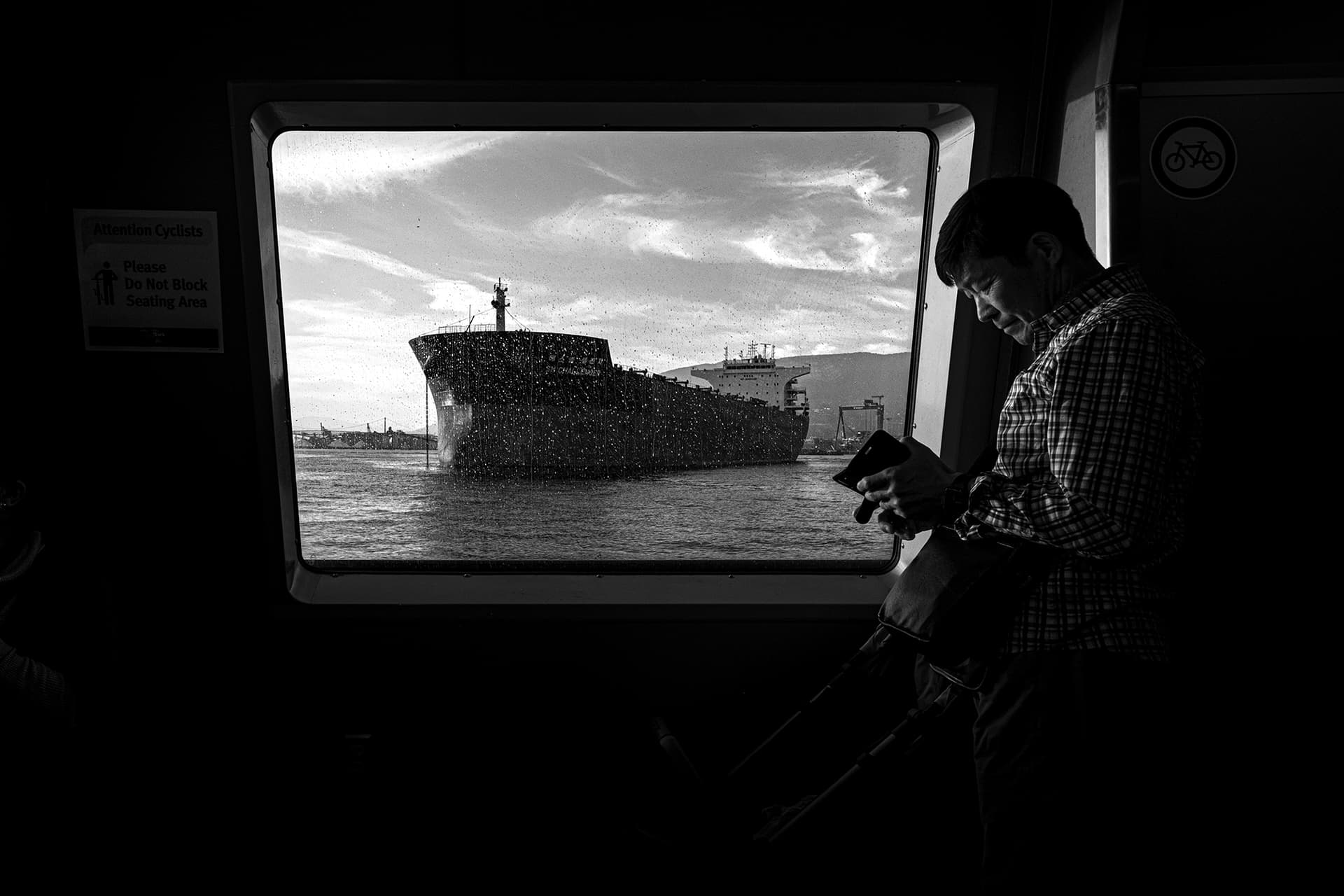
It's a twenty-minute ride one way. I sat for a couple of minutes, then started moving, just walking the cabin, watching what the light kept doing to people. Passed this man leaning against the wall, plaid shirt, head down on his phone. Filed him as interesting and kept walking.
A few seconds later I clocked the cargo ship. Big one. About to pass the same window the man was leaning next to. I walked fast back to the spot. Not running. Running draws the wrong kind of attention. Just fast enough.
Then I pretended to hang out. This is one of those things you have to learn the slow way. New street photographers make people uncomfortable because they've decided they need to be invisible, and the trying becomes the giveaway. The trick is to not try. Just be in the space like you have any other reason to be there. The self-consciousness is what people read, not the camera.
I settled near the man like I was just another passenger, framed up with the camera quiet, and waited for the ship to slot perfectly inside the window. He never looked up. He didn't owe me anything. He was on his phone.
16mm. The wide lets the dark interior frame the bright window without crowding the man on the right. Frame within a frame, and the cargo ship slotted perfectly inside that inner frame, both edges aligned with the glass. The ship's horizon line cuts through the window roughly on its own internal upper third, which puts the freighter's mass in the lower two-thirds and the cloud structure on top. The man sits on the right vertical third of the full frame, head tilted at the phone he was reading. Black and white because the light was already binary: interior dark, exterior bright. Adding chroma would have softened the contrast.
I called it Boat Diaries. Not because the SeaBus is my regular commute. It isn't. Because that crossing was an entry in the log of departures from routine. The everyday days walk past you and you don't notice them. The strange days, the somewhere-else days, those you remember. This is one of them. A man on his phone. A floating apartment block in the window. A photographer who got there fast enough.
Why It Works
Composition
The window is the structural device. A bright rectangle cut hard against the dark interior of the cabin. Classic frame within a frame, and the four window vertices align with the photo's diagonals. The window slots into the photo like a piece into a puzzle.
The horizontal symmetry axis runs through the photo's centre, which is also where the cargo ship's waterline sits inside the window. Sky on top, ship on the line, water as the spine. The repetition isn't a mirror, but the geometry centres on that line.
Now the man. His face sits at the left vertex of the first golden triangle, just slightly off the upper-right thirds power point. Close enough that the rules pull the eye toward him without locking him to a single mark. The bottom edge of the window aligns with the phi-grid baseline of the golden spiral, which curls up and right toward the same face. Three different rules quietly leading to one point. A man on his phone.
Light & Tone
The SeaBus has a particular light. Big windows, dark interior, so the light from outside picks its spots inside the cabin. Those spots fill with light, switch on. Whatever's outside them disappears. In this frame the man sits in one of those spots just enough to see his shirt and phone, but his face stays half-shadowed. The window itself is the brightest plane. Black and white in the edit because the cabin had already done the value separation for me. The interior is true black, the exterior is high-key, nothing in between.
Punctum
Roland Barthes again. The detail that pricks. Here it's the phone screen, faintly glowing in his hand, completely uninterested in the floating apartment block passing four metres behind his head. He's not avoiding the spectacle. He just has somewhere else to be, which happens to be a small rectangle of his own. The photograph captures the precise gesture of the modern attention transaction. Whatever the cargo ship wants, the phone wants more.
Timing
The window of opportunity wasn't the ship passing. It was the moment the ship sat perfectly inside the SeaBus window, both edges aligned with the glass. Big freighters move slow, but that exact alignment is short. I had to clock the ship from across the cabin, walk fast back to the spot, settle into a non-camera-pose, and trip the shutter the second the geometry locked. The man on his phone was patient. Cargo ships, less so.
Theme
I don't usually take the SeaBus. That afternoon I'd burned out on the same ten blocks I was walking every day. Sometimes the eye needs a different city, even if it's the same city via a different vehicle. Boat Diaries is the log of those departures. The days you go somewhere not yours and the city hands you something it had no obligation to. A man on his phone. A massive ship behind him. A photographer who showed up because he was tired of his usual streets.
Technical
- Camera
- FUJIFILM X-T3
- Focal length
- 16mm
- Aperture
- f/7.1
- Shutter
- 1/125s
- ISO
- 160
- Date
- OCT 19, 2022
- Location
- Vancouver, Canada
- Editor
- Lightroom